
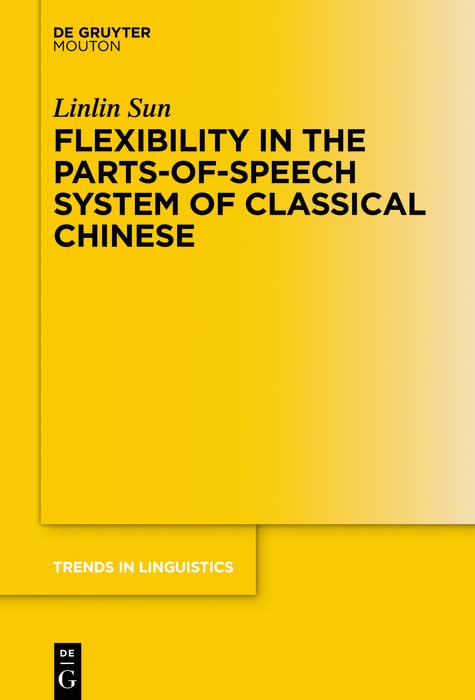
Flexibility in the Parts-of-Speech System of Classical Chinese
Product details
| Management number | 233642988 | Release Date | 2026/06/27 | List Price | US$41.56 | Model Number | 233642988 | ||
|---|---|---|---|---|---|---|---|---|---|
| Category | |||||||||
Languages across the world differ from each other in a number of respects, and one such difference is in terms of how their lexicons are categorized. Compared to most European languages with distinct, functionally dedicated word classes in the traditional sense, quite a few languages are observed to possess lexical items that can fulfill the functions typically associated with more than one traditional word class such as ‘noun’ and ‘verb’. According to Rijkhoff and van Lier (2013), these lexemes exhibit what is called ‘flexibility’. Classical Chinese is observed to feature word-class flexibility, in the sense that there are lexemes that can be used to serve the functions of two or more traditional word classes, without the functional change being marked by any derivational means. For instance, a lexical item like xìn can either function as a verb meaning ‘to be trustworthy [intr.]’ or ‘to believe, to trust [tr.]’ or serve as a noun meaning ‘trust, oath of alliance’. Similarly, a human-denoting lexeme such as yŏu FRIEND cannot only mean ‘a friend’ but also ‘to be a friend, to behave friendly [intr.]’, ‘to make friends with [tr.]’ or ‘to consider as a friend [tr.]’; an instrument word like biān WHIP cannot only mean ‘a whip’ but also ‘to whip’. This situation is often thought to be related to the fact that Classical Chinese does not have any kind of productive morphology in the traditional sense (e.g. Zádrapa 2011). This is reflected in the lack of markedness distinctions across Croft’s (2000, 2001) conceptual space for parts of speech. This study ascribes flexibility of parts of speech in Classical Chinese to precategoriality, in line with Bisang (2008 a, b). Precategoriality can roughly be defined as the absence of the noun-verb distinction in the lexicon; instead, the linking of individual words to the syntactic position of N or V as well as their text frequency in these positions are subject to pragmatics. Precategorial lexical items are those that are not preclassified into parts of speech in the lexicon; rather, their word-class specification is ultimately determined at the syntactic level, according to their position/function in a given word-class indicating construction. From a diachronic viewpoint, this study assumes that precategoriality and categoriality of individual lexical items are not static, but that they are potentialities and tendencies that may change over time. Specifically, (full) precategoriality and (full) categoriality are assumed to constitute a continuum in the lexicon of Chinese throughout its history. In any given historical period, lexical items of the language are distributed between the two extremes on the continuum, according to the intensity of the association between their lexical meaning and the syntactic position/function of e.g. N or V. Generally, along the continuum at a given historical stage, lexemes with a strong association between meaning and function (i.e. lexemes that are normally associated only with one word-class specification for a particular syntactic role) tend to be located close to the extreme of (full) categoriality. In contrast, lexemes that are not necessarily related to one specific association between meaning and function, but can potentially occur in a variety of such associations, are assumed to be placed closer to (full) precategoriality instead. Roughly speaking, the group of lexemes that is located towards (full) precategoriality are flexible lexemes, though with varying degrees of flexibility, whose semantics licenses a syntactic variety and can thus be linked to more than one word-class specification through syntactic specification, a syntactically specified process of category assignment. Based on these considerations, this study aims to present the results of a corpus-based investigation into flexibility of parts of speech in Classical Chinese. The research focuses on two types of syntactic specifications of flexible lexemes, namely, those using... Read more
| ASIN | B084V3HVMM |
|---|---|
| XRay | Not Enabled |
| ISBN13 | 978-3110660876 |
| Edition | 1st |
| Language | English |
| File size | 31.4 MB |
| Page Flip | Enabled |
| Publisher | De Gruyter Mouton |
| Word Wise | Not Enabled |
| Print length | 427 pages |
| Accessibility | Learn more |
| Screen Reader | Supported |
| Part of series | Trends in Linguistics. Studies and Monographs [TiLSM] |
| Publication date | February 10, 2020 |
| Enhanced typesetting | Enabled |
Bestseller ranking
Germany



Customers who viewed this product also viewed
Chinese


Correction of product information
If you notice any omissions or errors in the product information on this page, please use the correction request form below.
Correction Request Form